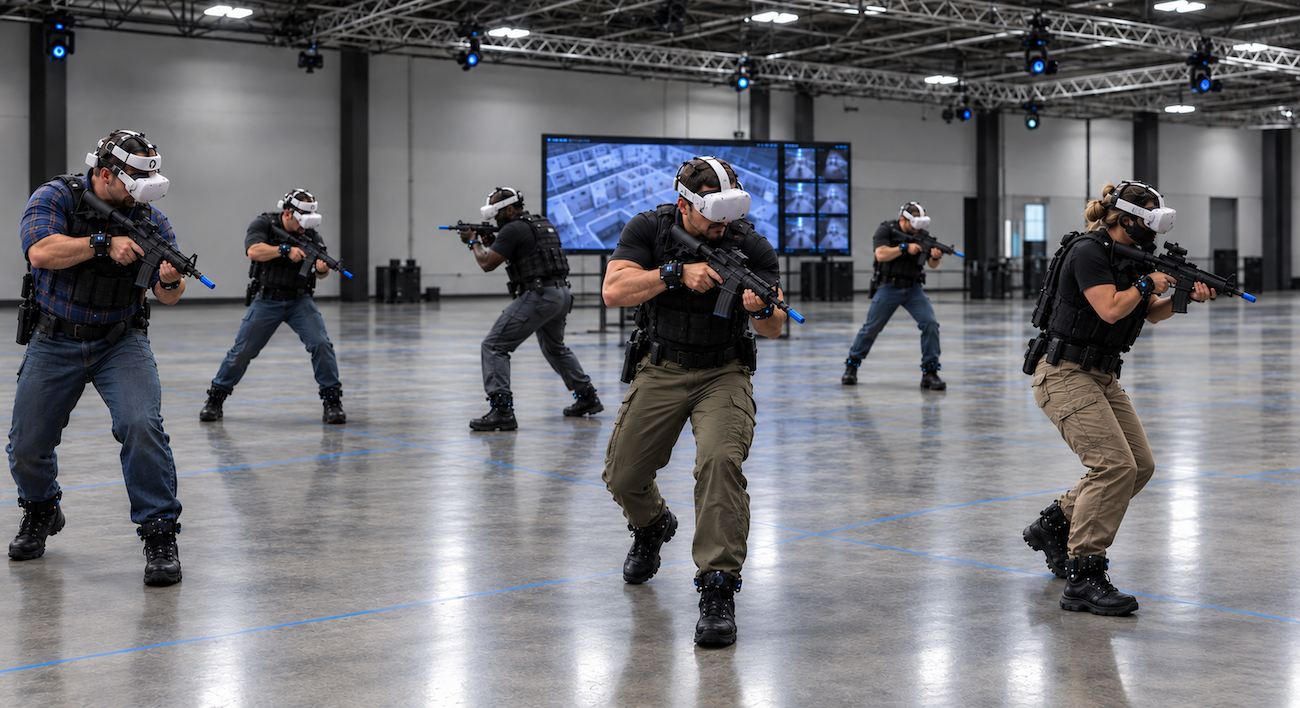
Active shooter response is never a solo exercise. It’s a coordinated, high-stress team event — communication, movement, sector coverage, and split-second decisions made in concert with other officers. Yet a lot of VR training systems on the market today are still built around single-trainee, shoot/no-shoot reps. For agencies evaluating VR as part of their active shooter curriculum, the real question isn’t “does it look realistic?” — it’s “can my whole team train together, in the same virtual space, and get measurable feedback on how they performed as a unit?”
Here’s what to look for.
1. Genuine free-roaming movement, not fixed positions
A trainee standing still in front of a screen isn’t rehearsing what officers actually do during an active shooter response — moving to cover, closing distance, clearing a room, redeploying as a threat picture changes. Systems that tether trainees to a stationary point limit training to a narrow slice of the real event.
2. Real multi-trainee collaboration at scale
The Department of Homeland Security’s National Urban Security Technology Laboratory (NUSTL) ran an independent market survey of 21 commercial VR training products for first responders. In that comparison, training footprints varied widely — many systems topped out under 1,300 sq ft. V-Armed’s listed range in the same survey was 900 to 40,000 sq ft, supporting up to 10 trainees who can see, hear, and coordinate with each other inside the same environment. Space matters here: clearing a two-level building with a four-person team requires room to actually maneuver, not a shrunken stand-in for it.
3. Full-body avatar tracking
Seeing a teammate’s whole body — not just a floating headset and hands — is what makes squad-based training feel real enough to produce a genuine stress response and build muscle memory officers can draw on later. V-Armed uses a patented full-body inverse kinematic tracking system (FBIKS) with sub-millimeter accuracy, letting trainees see each other’s posture, positioning, and muzzle direction in real time.
4. Low latency, to keep the team in the fight
When a system lags behind a trainee’s actual movement, the result is disorientation or simulator sickness — and a training session cut short. Low motion-to-photon latency isn’t a nice-to-have for team exercises; it’s what lets a four- or six-person squad run a scenario start to finish without someone tapping out.
5. Scenario authoring tied to your agency’s actual protocols
Canned, pre-scripted scenarios don’t reflect the buildings, procedures, or threat profiles specific to your jurisdiction. V-Armed’s Dispatch software lets training staff build and edit unlimited custom scenarios — schools, transit systems, hotels, retail — and layer in AI-driven non-player characters, weather, and lighting changes, so instructors control the objective rather than the vendor.
6. After-Action Review built for team debriefs
A team exercise needs team-level data: who covered which sector, where communication broke down, whose reaction time lagged. V-Armed’s AAR system replays the full session from any point of view — including an overhead “trainer’s view” — while capturing reaction time, shots fired, muzzle discipline, and biometric stress indicators for every participant simultaneously.
V-Armed’s systems are already running team-based active shooter and counterterrorism training at LAPD, the NYPD Counterterrorism Bureau, DHS Federal Protective Service, and LSU’s National Center for Biomedical Research and Training (NCBRT) — one of DHS’s own nationally sponsored active shooter training providers. If your agency is evaluating VR for squad-level active shooter response, that’s the bar to measure against: not just realism, but a system built to scale with your team, your space, and your protocols.
Want to learn how V-Armed Training Solutions have revolutionized officer readiness in cities all across the US? Contact Us