
Law enforcement agencies face increasing pressure to prepare officers for complex, high-risk situations—while minimizing danger, liability, and cost. Traditional classroom instruction and live role-playing exercises remain valuable, but they often fall short in replicating the intensity and unpredictability of real-world encounters.
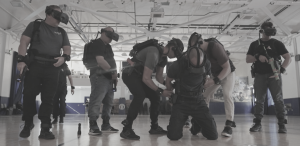 Police VR training is rapidly emerging as a powerful solution. By using immersive virtual reality simulations, agencies can train officers in realistic scenarios that improve decision-making, situational awareness, and de-escalation skills—without exposing officers or the public to risk.
From Traditional Training to Virtual Reality Police Training
Historically, police training relied on lectures, tabletop exercises, and staged role-play. While effective for foundational knowledge, these methods offer limited realism and scalability.
Virtual reality police training changes that equation. With VR headsets and simulation software, officers can experience:
- Active shooter incidents
- Traffic stops and pursuits
- Domestic disturbance calls
- Crisis negotiation scenarios
All within a controlled, repeatable environment that mirrors real-world conditions.
Key Benefits of Police VR Training
Safer Training for High-Risk Scenarios
VR provides a risk-free environment for practicing dangerous situations such as:
- Use-of-force decision-making
- Hostage negotiations
- Armed confrontations
Officers can make mistakes, learn from them, and repeat scenarios without real-world consequences.
Enhanced Situational Awareness & Decision-Making
Immersive simulations improve cognitive readiness by placing officers under realistic stress conditions. Repeated exposure strengthens:
- Threat recognition
- Tactical positioning
- Verbal communication and de-escalation
This leads to faster, more effective decision-making in the field.
Cost-Effective and Scalable Training
Compared to live exercises, law enforcement VR training:
- Reduces the need for physical props and locations
- Minimizes overtime and staffing disruption
- Allows unlimited scenario repetition
Departments can train more officers, more often, at a lower long-term cost.
Real-World Adoption of Police VR Training
LAPD: Advancing Scenario-Based Training
The Los Angeles Police Department has implemented VR training modules to prepare officers for both routine and high-risk encounters. These simulations allow officers to experience diverse scenarios and refine responses before facing similar situations in real life.
NYPD: Active Shooter & Crisis Simulations
The NYPD has tested VR-based drills focused on active shooter response and crisis intervention. Early results indicate improved preparedness and confidence among participating officers.
V-Armed: Immersive Training at Scale
V-Armed, a New York-based VR training provider, develops large-scale, multi-user simulations tailored specifically for law enforcement. Their technology enables departments to conduct realistic, mission-ready training that was previously difficult or impossible to replicate safely.
The Future of Virtual Reality in Law Enforcement Training
As technology advances, VR is expected to become a core component of police training programs nationwide. Future applications include:
- Advanced de-escalation and crisis intervention training
- Community-policing scenario simulations
- Leadership and command-level decision exercises
Challenges remain—such as technology adoption and training integration—but the benefits continue to outweigh the barriers.
How Law Enforcement Agencies Can Implement Police VR Training
Select the Right VR Training Platform
Agencies should prioritize solutions that offer:
- Customizable law enforcement scenarios
- Multi-user training environments
- Performance tracking and analytics
Align VR With Department Training Goals
VR modules should reflect real challenges officers face daily, reinforcing departmental policies and use-of-force guidelines.
Train Instructors and Supervisors
Successful implementation requires trainers who understand both the technology and instructional design, ensuring VR enhances—not replaces—existing training frameworks.
Conclusion: Setting a New Standard for Police Training
Police VR training represents a significant evolution in how law enforcement agencies prepare officers for the realities of modern policing. By combining realism, safety, and scalability, virtual reality enhances readiness while reducing risk and cost.
For agencies committed to improving officer performance, accountability, and community outcomes, virtual reality law enforcement training is no longer experimental—it’s essential.
Departments exploring the future of police training should consider how VR can strengthen their programs, elevate officer preparedness, and set a new standard for public safety education.