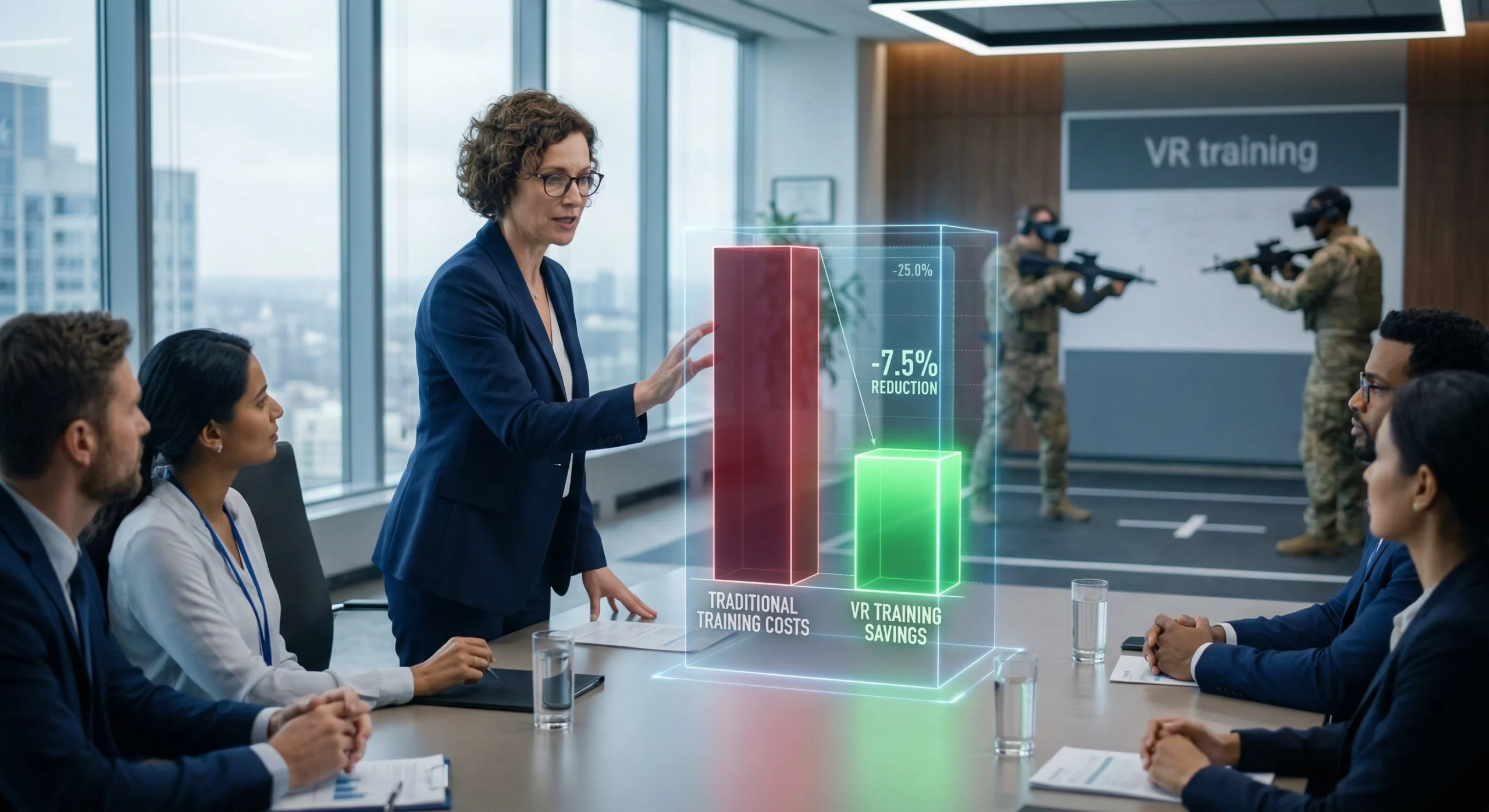
As we navigate the fiscal landscape of 2026, the “wait and see” approach to immersive technology has ended. For CFOs and procurement officers in high-stakes industries—ranging from law enforcement to private security and industrial operations—the conversation has shifted from “What does VR cost?” to “What is the cost of not using VR?”
When performing a VR training cost-benefit analysis, the numbers tell a compelling story of risk mitigation and radical efficiency. At V-Armed, we help organizations move beyond hardware enthusiasm into measurable financial performance.
The Hidden Costs of Traditional Training
Traditional, “analog” training for high-risk professions carries a heavy financial burden that often hides in plain sight:
- Logistics and Travel: Transporting teams to physical facilities, housing, and per diems.
- Consumables: Ammunition, fuel, medical supplies, and PPE that are destroyed during use.
- Opportunity Cost: The downtime of personnel while they are in transit or waiting for range availability.
- Liability: The astronomical cost of settlements resulting from “failure to train” or “improper training” in high-stress scenarios.
VR Training Cost-Benefit Analysis: The 2026 Breakdown
In 2026, the ROI of immersive simulations is driven by three pillars: Scalability, Retention, and Risk Transfer.
1. Radical Reduction in OpEx
Traditional drills are “one-and-done.” Once the blank is fired or the vehicle is driven, the money is spent. V-Armed’s immersive simulations allow for infinite repetitions at zero marginal cost.
- Key Stat: Organizations utilizing V-Armed’s large-scale VR environments report a 40-60% reduction in training-related travel and consumable costs within the first 18 months.
2. Liability Mitigation & Insurance Premiums
Perhaps the most significant ROI factor is the reduction of legal liability. In high-stakes environments, the ability to prove a “standard of care” through data is vital. V-Armed’s platform tracks every movement, decision, and reaction time.
- The “Defensible Data” Advantage: If a critical incident occurs, having a digital twin of the officer’s training history provides a powerful defense against negligence claims.
- Insurance Impact: Many underwriters in 2026 are beginning to offer premium discounts for organizations that utilize V-Armed’s high-fidelity simulations due to the verifiable proficiency of the staff.
3. Accelerated Time-to-Proficiency
The “Service” value of VR lies in its ability to condense months of experience into weeks. Through “stress-inoculation,” trainees can experience the cognitive load of a 10-year veteran before they ever step into the field. This reduces the “rookie error” window where most costly accidents occur.
Integrating V-Armed into Your 2026 Budget
For procurement leaders, the shift to VR often represents a move from CapEx (Capital Expenditure) to a more manageable SaaS or Service-based OpEx model. By partnering with V-Armed, you aren’t just buying headsets; you are investing in a comprehensive training-as-a-service (TaaS) ecosystem that scales with your headcount.
Key Takeaway for CFOs
“The initial investment in VR is offset by the elimination of recurring logistics costs and the catastrophic prevention of a single multi-million dollar liability lawsuit.”
Conclusion: The Future is Immersive (and Profitable)
The financial mandate for 2026 is clear: optimize or stagnate. A VR training cost-benefit analysis reveals that immersive tech is no longer a luxury—it is a fiscal safeguard.
By leveraging V-Armed’s industry-leading simulation technology, your organization can ensure that every dollar spent on training is an investment in safety, proficiency, and bottom-line protection.
Ready to see the numbers for your organization? Request a V-Armed ROI Assessment and Demo Today